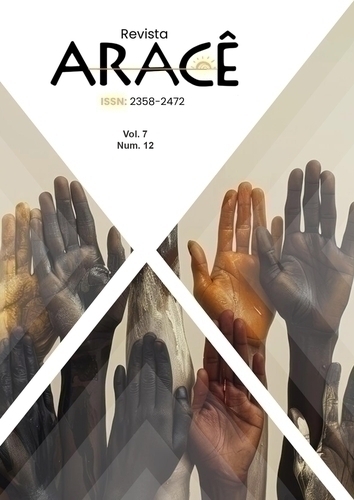
RACIALIZAÇÃO, VIÉS ALGORÍTMICO E PODER NA ERA DA INTELIGÊNCIA ARTIFICIAL: UMA ANÁLISE CRÍTICA DAS NOVAS ARQUITETURAS TECNOLÓGICAS
DOI:
https://doi.org/10.56238/arev7n12-342Palavras-chave:
Inteligência Artificial (IA), Algoritmos, Viés Algorítmico, Racismo AlgorítmicoResumo
Este artigo analisa a relação entre tecnologia, inteligência artificial e questões raciais, destacando como os sistemas automatizados refletem valores e preconceitos que podem agravar discriminações e disparidades sociais. Discutem-se os conceitos de racismo algorítmico e racismo estrutural presentes na criação, implementação e utilização de tecnologias como reconhecimento facial, sistemas de seleção automatizada e plataformas online. A partir de uma perspectiva foucaultiana de biopoder, destaca-se a importância de se questionar a suposta neutralidade tecnológica, evidenciando-se como as decisões automatizadas podem intensificar a opressão racial, através de práticas de segregação digital ao reforçarem estereótipos. Também são examinados aspectos históricos e teóricos relacionados ao progresso tecnológico e suas implicações sociopolíticas, especialmente no contexto atual de poder e controle social. Por fim, este estudo visa contribuir para uma reflexão sobre justiça e equidade no emprego da inteligência artificial.
Downloads
Referências
ALAGIĆ, A. et al. Application of artificial intelligence in the analysis of the facial skin health condition. IFAC-PapersOnLine, 2022. v.55, n.4, p.31-37. Disponível em: <https://doi.org/10.1016/j.ifacol.2022.06.005>. DOI: https://doi.org/10.1016/j.ifacol.2022.06.005
ARROYO, C. L. Constitución, Derechos Fundamentales, Inteligencia Artificial Y Algoritmos. Revista do Direito, 2022, n.66, p.139-158. DOI: https://doi.org/10.17058/rdunisc.vi66.17635
BENJAMIN, Ruha. Race After Technology: Abolitionist Tools for the New Jim Code. Oxford: Oxford University Press, 2019.
BHBOSALE, S.; PUJARI, V.; MULTANI, Z. Advantages and disadvantages of artificial intelligence. Aayushi International Interdisciplinary Research Journal, 2020, v.77, n.October, p.227–230. Disponível em: <https://towardsdatascience.com/advantages-and-disadvantages-of-artificial-intelligence-182a5ef6588c>.
BOONIPAT, T. et al. Using artificial intelligence to analyze emotion and facial action units following facial rejuvenation surgery. Journal of Plastic, Reconstructive and Aesthetic Surgery, 2022, n.XXV, p.8-10. DOI: https://doi.org/10.1016/j.bjps.2022.08.007
BUOLAMWINI, Joy Adowaa. Gender Shades: Intersectional Phenotypic and Demographic Evaluation of Face Datasets and Gender Classifiers. B.S. in Computer Science, Georgia Institute of Technology, 2017. Massachusetts Institute of Technology.
BUOLAMWINI, Joy & GEBRU, Timnit. Gender shades: Intersectional accuracy disparities in commercial gender classifcation. In Conference on fairness, accountability and transparency. Proceedings of Machine Learning Research, v.81, pp.1-15, 2018. In: http://proceedings.mlr. press/v81/buolamwini18a/buolamwini18a.pdf. Acessado em 20 jun.
CARPENTER, K. A.; HUANG, X. Machine learning-based virtual screening and its applications to Alzheimer’s drug discovery: a review. Current pharmaceutical design, 2018, v.24, n.28, pp.3347-3358. DOI: https://doi.org/10.2174/1381612824666180607124038
CORMEN, Thomas H. et al. Algoritmos: Teoria e Prática. 3.ed. Rio de Janeiro: Elsevier, 2012.
ELIAS, P. S. Algoritmos, Inteligência Artificial e o Direito. ConJur, 2017. Disponível em: <https://www.conjur.com.br/dl/algoritmos-inteligencia-artificial.pdf>. Acesso em: 3 out. 2022.
FOUCAULT, Michel. História da sexualidade I. Trad. Maria Thereza da Costa Albuquerque e J. A. Guilhon Albuquerque. Rio de Janeiro: Edições Graal, 1998.
FOUCAULT, Michel. Vigiar e Punir: Nascimento da Prisão. 42.ed. Petrópolis: Vozes, 2020.
HAN, Byung-Chul. Sociedade do cansaço. Trad. Enio Paulo Giachini. Petrópolis: Vozes, 2025.
HAYKIN, S. Neural Networks and Learning Machines. New Jersey: Prentice Hall, 2008.
HELMOND, ANNE. A plataformização da web. In: OMENA, J. J. Métodos Digitais: Teoria-Prática-Crítica. Lisboa: ICNOVA, 2019. pp.49-72.
HIMANSHU; KHANNA, R.; KUMAR, A. Artificial intelligence applications for target node positions in wireless sensor networks using single mobile anchor node. Computers and Industrial Engineering, 2022. v.167, n. February. DOI: https://doi.org/10.1016/j.cie.2022.107998
MASTRODICASA, D. et al. Artificial Intelligence Applications in Aortic Dissection Imaging. Seminars in Roentgenology, 2022. DOI: https://doi.org/10.1053/j.ro.2022.07.001
MIRA, J. M. Symbols versus connections: 50 years of artificial intelligence. Neurocomputing, 2008. v.71, n.4-6, p.671-680. DOI: https://doi.org/10.1016/j.neucom.2007.06.009
MOACIR, R. F. de M. & PONTI, M. A. Machine learning A Practical Approach on the Statistical Learning Theory. [S.l.]: [s.n.], 2017. v.45.
NAKAMURA, L. & CHOW-WHITE, P. Introduction - Race and Digital Technology: Code, the Color Line and Information Society. In: NAKAMURA, L. CHOW-WHITE, P. (Orgs.). Race after the internet. New York: Routledge, 2012, pp.1-18. DOI: https://doi.org/10.4324/9780203875063
NOBLE, Safiya Umoja. Algoritmos da opressão: como o Google fomenta e lucra com o racismo. Santo André, SP: Rua do Sabão, 2021.
O’NEIL, Cathy. Algoritmos de destruição em massa: como o Big Data aumenta a desigualdade e ameaça à democracia. Trad. Rafael Abraham. Santo André, SP: Rua do Sabão, 2020.
PEIXOTO, F. H. Direito E Inteligência Artificial Na (Não) Redução De Desigualdades Globais: Decisões Automatizadas Na Imigração E Sistemas De Refugiados. Revista Direitos Culturais, 2020, v.15, n.37, p.305-320. DOI: https://doi.org/10.20912/rdc.v15i37.222
SHAPIRO, S. C. Encyclopedia of artificial intelligence second edition. New Jersey: A Wiley Interscience Publication, 1992. p.1-9.
SILVA, T. Colonialidade difusa no aprendizado de máquina: camadas de opacidade algorítmica na internet. In: SILVEIRA, S. A. da; SOUZA, J. & CASSINO, J. F. (Orgs.). Colonialismo de Dados. São Paulo: Autonomia Literária, 2021. pp.87-108.
SILVA, T. Racismo Algorítmico em Plataformas Digitais: microagressões e discriminação em código. VI Simpósio Internacional LAVITS – Assimetrias e (In)Visibilidades: vigilância, Gênero e Raça, 2019b. pp.1-17.
SOUSA, Vinicius Dino de. O problema do algorithmic bias (viés algorítmico) no auxílio aos juízes de Direito pela inteligência artificial: Uma investigação sobre a imparcialidade e injustiça da inteligência artificial. 2020, https://www.jusbrasil.com.br/artigos/o-problema-do-algorithmic-bias-vies-algoritmico-no-auxilio-aos-juizes-de-direito-pela-inteligencia-artificial/825348884. Acessado em 15/08/2024.
SWEENEY, Latanya. Discrimination in Online Ad Delivery (28 de janeiro de 2013). Disponível em SSRN: https://ssrn.com/abstract=2208240 ou http://dx.doi.org/10.2139/ssrn.2208240. DOI: https://doi.org/10.2139/ssrn.2208240
TRIVEDI, R. & KHADEM, S. Implementation of artificial intelligence techniques in microgrid control environment: Current progress and future scopes. Energy and AI, 2022, v.8, n. March, p.1-19. DOI: https://doi.org/10.1016/j.egyai.2022.100147
TSIKTSIRIS, D. et al. A Novel Image and Audio-based Artificial Intelligence Service for Security Applications in Autonomous Vehicles. Transportation Research Procedia, 2022. v.62, n. Ewgt 2021, pp.294-301. DOI: https://doi.org/10.1016/j.trpro.2022.02.037
TUFEKCI, Z. Algorithmic Harms beyond Facebook and Google: Emergent Challenges of Computational Agency. Colorado Technology Law Journal, 13, pp.203-218, 2015.
ZHOU, J. et al. Application of artificial intelligence in the diagnosis and prognostic prediction of ovarian cancer. Computers in Biology and Medicine, 2022, v.146, n. February, p.105608. Disponível em: <https://doi.org/10.1016/j.compbiomed.2022.105608>. DOI: https://doi.org/10.1016/j.compbiomed.2022.105608
ZHU, L. et al. Can artificial intelligence enable the government to respond more effectively to major public health emergencies? Taking the prevention and control of Covid-19 in China as an example. Socio-Economic Planning Sciences, 2022, v.80, n. December 2020, pp.1-9. DOI: https://doi.org/10.1016/j.seps.2021.101029
ZUBOFF, S. A era do capitalismo de vigilância. Rio de Janeiro: Intrínseca, 2021.